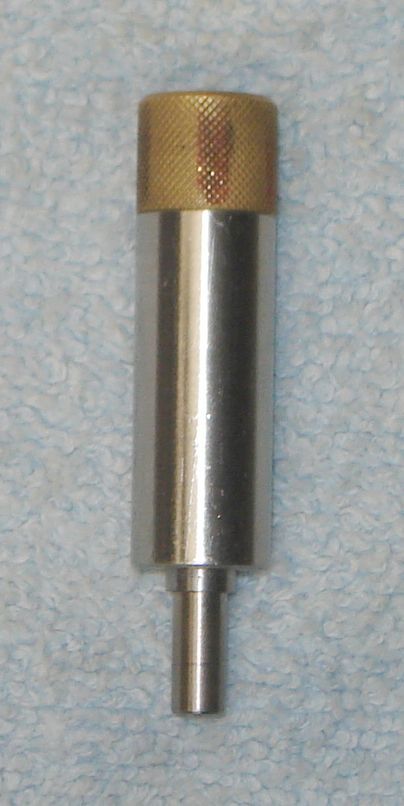
Spin Toy (Click to enlarge)
* GadgetBuilder.com * © 2026 by John Moran
Last Modified:
Spin Toy (Click to enlarge)
I ran across the Metmo Figet Piston and wondered how difficult it would be to make something similar. It turned out to be only a little more difficult than anticipated. My version does most of the things shown on the Metmo site except it won't launch the piston (this could damage the piston so it isn't prudent in my opinion). Dimensions are somewhat arbitrary; sizes below were set by material I had on hand.
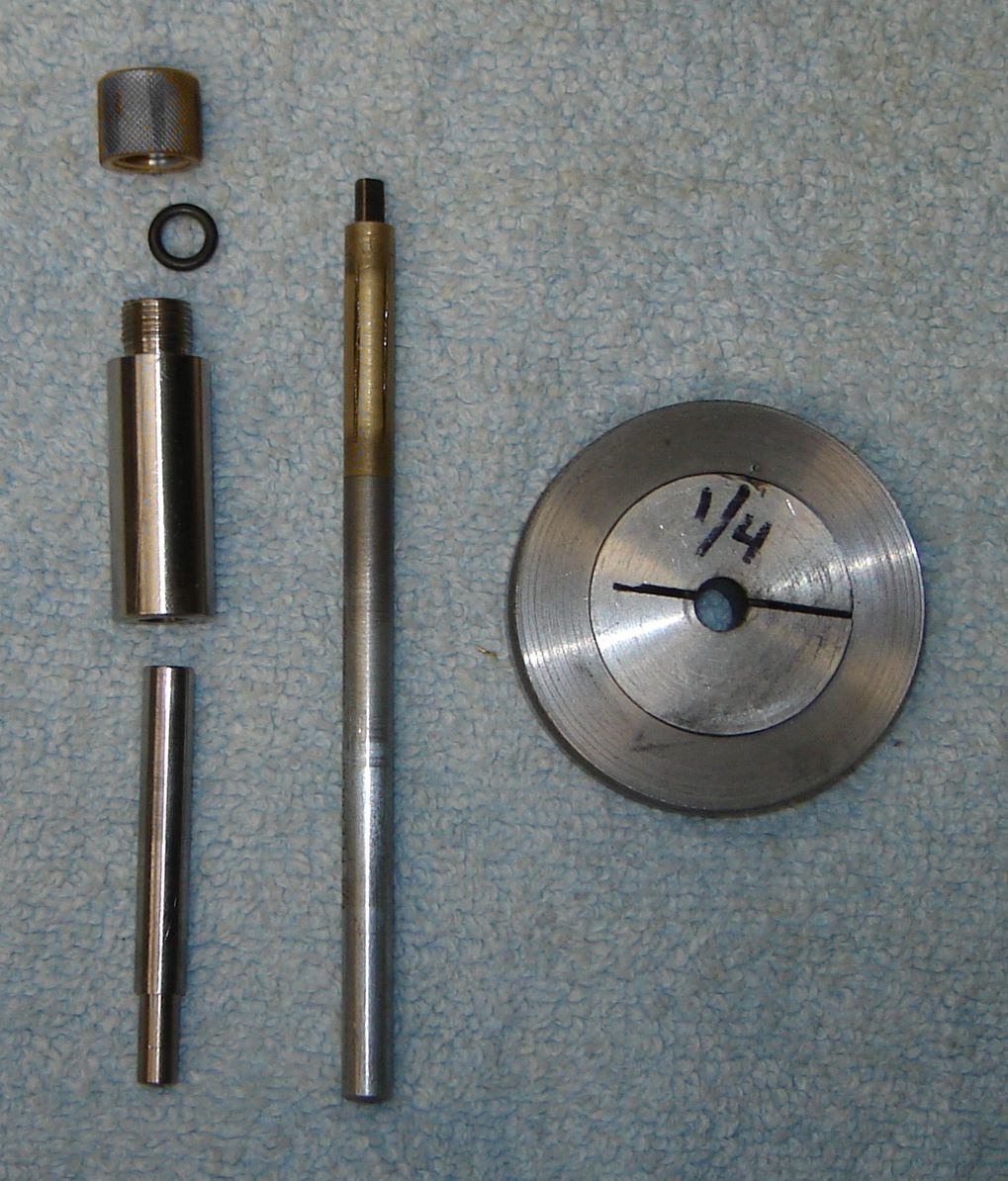 The parts and the laps used for finishing are shown in the picture at right(click to enlarge).
The body is a piece of rod from a discarded line printer, 1/2" by 1.75". This is drilled through with a "C" size drill then reamed to 0.250, followed by lapping to about 0.251. Lapping ensures the hole is round and the same diameter from end to end - verified by the feel of the lap as it traverses the length. One end of the body is turned down to 0.350 for a length of 0.275; this was threaded 32tpi (my default for many things).
The cap is 1/2" brass rod 0.430 long; the end was drilled 0.360 deep with an "M" drill, then bored to 0.325 and the bottom was flattened with the boring bar. It was then threaded 32tpi. Verify that it mates nicely with the body and knurl it before parting off. Even though the surfaces where the top meets the body are nicely finished they are not air tight on my unit so I needed an O ring in the top to get an air tight seal.
The piston is from a 0.275 (7mm) line printer rod. A 2 inch length was turned down to 0.252 or at least that was the plan. The outer end deflected so it was slightly over size. I tried to remove a half thou with the vertical shear tool, easily done on more rigid work, and managed to remove nearly a full thou. This left less than a thou for lappin in the lower half inch of the piston so the eventual fit in that area isn't as good as on the remainder of the piston. A grip area 0.2 in diameter and 0.4" long was turned on the lower area of the piston. The piston was parted off and the top end was chamfered slightly to make it easier to insert into the body. The grip area was held in the lathe chuck and the piston was lapped to 0.251+ over its length; it felt looser toward the bottom of the piston during lapping, making it clear I had botched the attempt to rectify the earlier problem caused by deflection of the work. Trial fit and additional lapping continued until the piston would enter the body. This fitting took a while since lapping is a slow process; I didn't want to lap too far and cause a loose fit but it did need to be loose enough to allow the body to spin on the piston. Avoid forcing the piston into the body lest they get stuck due to the precise fit.
This toy when spinning uses an air bearing to minimize friction. Before initial use it must be cleaned to remove all oil - even a slight amount of oil from touching the piston with your fingers will reduce the spin time dramatically. My unit will spin for about 35-45 seconds but if I touch the piston this reduces to about 5 seconds; wiping the piston restores operation. I did deliberately get a bit more oil on the piston as a test and wiping the piston didn't restore operation - I had to clean the inside of the body several times with bits of paper towel as well as clean the piston to get it going again. On the other hand, it travels well - it can be kept in a pocket and pulled out during idle times when it will work nicely. Dust from pockets doesn't seem to affect operation.
Metmo used non-magnetic material so they made the piston the same length as the body. I used magnetic material (steel) for the body and piston. Note that the piston grip protrudes outside of the body. This is necessary because the piston doesn't exit due to gravity (as the Metmo does), possibly due to slightly magnetic parts. Note that like the Metmo unit the piston must be pulled out a quarter inch or more prior to spinning else it will stop early. The air bearing works in all orientations: up, down, or horizontal - it's a little less efficient when horizontal, runs about 25 seconds vs 35 seconds vertical.
If you have a comment on this site or its contents,
click here scroll down and click again.